USS North Carolina BB-55 Battleship
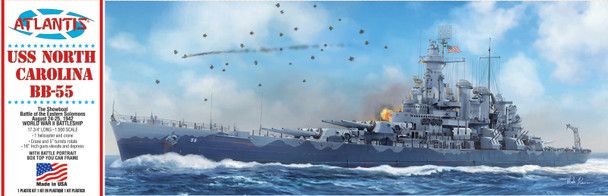
1:500 Scale. This kit features 144 parts and measures 17 3/4 inches long.
Molded in gray with display stand and decals for both Washington and
Carolina battleships. The US Battleship North Carolina (BB-55), lead ship
of a class of 35,000-ton battleships, was built at the Brooklyn Navy Yard.
The USS North Carolina was quickly nicknamed “The Showboat” because of all
the attention she drew during her trials in New York Harbor. At the time of
her commissioning on April 9th 1941, she was considered the world’s
greatest sea weapon. Armed with nine 16-inch/45 caliber guns in three
turrets, and twenty 5-inch/38 caliber guns in ten twin mounts, North
Carolina proved a formidable weapons platform. Her wartime complement
consisted of 144 commissioned officers and 2,195 enlisted men, including 86
Marines. In her modern version, the catapult-launched float planes have
been replaced by Helicopters for observation service.The North Carolina
went to the Pacific in June 1942. She took part in the Guadalcanal campaign
during the rest of that year, covering the initial landings there and
participating in the Battle of the Eastern Solomons in August 1942. She was
damaged by a Japanese submarine torpedo on September 15th that year, in an
attack that also fatally damaged USS Wasp (CV-7), but returned to the
Solomons combat zone after a few months’ repairs. During an enemy air
attack in the Battle of the Eastern Solomons, the North Carolina threw up
such a fierce barrage from her anti-aircraft batteries that the mighty
Carrier Enterprise signaled to her “ARE YOU AFIRE?!” due to all the
smoke.In November 1943, North Carolina assisted in capturing enemy
positions in the Gilbert Islands. This began a pattern of operations for
her that lasted for the rest of World War II: serving in the anti-aircraft
screen of aircraft carrier task forces and occasionally using her heavy
guns to bombard Japanese-held islands. In these roles, during 1944 she was
involved in the Marshalls operation in January-February, attacks on Central
Pacific targets through the late winter and spring, the Marianas invasion
and Battle of Philippine Sea in June, and Western Pacific carrier strikes
in November and December.North Carolina continued her Western Pacific
activities in 1945, participating in the invasions of Iwo Jima in February,
and Okinawa in March and April. The battleship also screened carriers on
raids throughout the combat zone, including attacks on the Japanese home
islands. Although this mighty naval battlewagon had been torpedoed,
dive-bombed, strafed, shelled, and suffered many near misses, she had never
been put out of commission by enemy action even though Tokyo Rose had
reported her as sunk no less than 6 times during the course of the Pacific
war! By the time the mighty “Showboat” steamed into Tokyo Bay and dropped
anchor on September 5th, 1945 after 40 months of action in the Pacific War,
her score was admirable. She was credited with destroying 27 Japanese
aircraft plus a large number of probables. During 9 major naval
bombardments she destroyed literally billions of dollars worth of enemy
shore installations, Naval units, and personnel. She was truly a major
factor in the power that stopped the ascent of the “Rising Sun”, and a
stirring tribute to the many Americans who built, supplied, and manned her,
and the few who were wounded and died serving her.In 1961 the North
Carolina was transferred to the State of North Carolina to become a
memorial and museum at Wilmington, where she remains to this day.