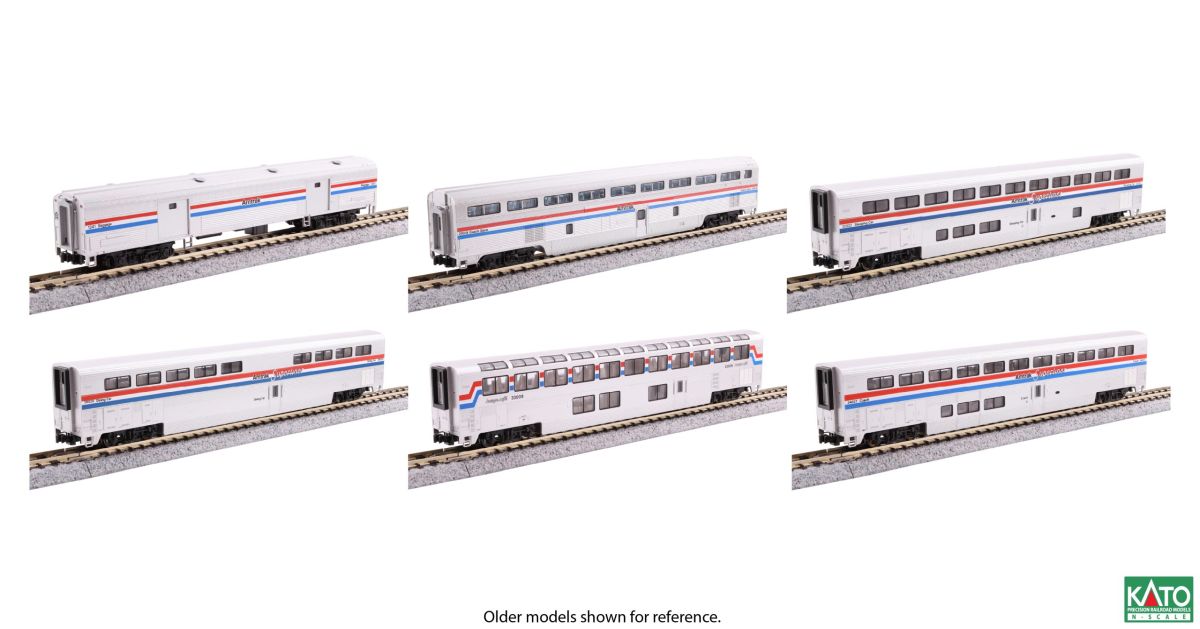

O Pan Am 2pk 70′ Smoothside/Ribbed Psg.Cars
The lightweight, streamlined passenger car was a product of the GreatDepression. While the heavyweight steel cars built in the teens and1920s were dependable and often luxurious, their dark colors and solid,battleship-like exteriors didlittle to lift the spirits at a time whenthe entire nation needed a pick-me-up. As noted railroad historian JohnH. White, Jr. put it in The American Railroad Passenger Car, “Some hopeduring these gloomy years was offered by a new designconcept calledstreamlining. It presented a sleek, modern image of speed andinnovation. What had been an obscure technical term in aerodynamics wasmade into a household word through an astute publicity campaign mountedby severalrailroad traffic departments. It succeeded in creating ageneral interest in railroading practically unknown since the openingof the first transcontinental line. According to Railway Age, ‘For thefirst time in many years, the words ‘sold out’ re-entered the ticketclerk’s vocabulary.'”
But as White notes, the real change in passenger carconstruction was in weight, not the streamlined appearance that waslargely for show: “Weight, not air friction, was the chief obstacle toeconomic operation.” Unlike the heavyweights, the lightweight cars thatdebuted in the mid-1930s featured sides and roofs that contributed totheir structural strength, eliminating the need for the heavyweights’massive underframes. Trucks went from six wheels to four, non-revenuespace was decreased by using a vestibule on only one end of the car,and lighter, stronger, more rust resistant steel alloys came intowidespread use. A typical new lightweight could be 15-20 tons lighterthan the heavyweight car it replaced.
As with the diesel revolution that was simultaneously takingplace, one of the key players in the changeover to lightweights was notan established industry name, but an upstart new player from theautomotive industry: the BuddCompany of Philadelphia, a supplier ofauto body stampings. In 1928, Edward G. Budd had heard about stainlesssteel, a lightweight, rustproof metal introduced in 1912 by Krupp ofGermany. Budd was the first to grasp the potential of stainless beyondcutlery and novelty items. The key problem was the inability ofstainless steel to be fabricated with normal welding techniques. Budd’schief engineer, Colonel Earl J.W. Ragsdale, spent five years developingthe key process needed to make stainless into a viable structuralmaterial: the patented Shotweld electric welding process.
Beginning with the Burlington’s Pioneer Zephyr of 1934,gleaming Budd-built trains, constructed almost entirely of stainless,helped define the look of the streamlined era to the American public -even on railroads like the Pennsylvaniaand Norfolk and Western thatpainted over the stainless with company colors. While other carbuilders such as Pullman countered with stainless-sheathed steel carslike the Southern Pacific’s Daylights, they were forced to use rivetsrather than welding for construction. In later years, the result wasthat Budd cars lasted almost indefinitely, while the stainless-sheathedimitators were plagued with out-of-sight rusting under the sheathing.
The majority of lightweights were 80′-85′ long, which scalesout to about 21″ in O gauge. Many O gauge modelers, however, find carsof this length impractical, as they require large curves and createlong trains that can overwhelm a typical-sized layout. For thosereasons, our Premier lightweights are about 70 scale feet in length -reproducing the look and feel of prototype streamliners in a model thatwill round O-42 curves with ease and look at home on mostscale-detailed O gauge layouts.
No other manufacturer matches the quality and value foundinside an M.T.H. Premier Line passenger car. Using an intricatelydetailed, yet durable ABS body atop smooth rolling die-cast metaltrucks results in a lightweight car that won’t bog down a locomotivestruggling to pull heavy aluminum passenger cars. What’s more, eachPremier Line passenger car features detailed car interiors and overheadlighting for a realistic and authentic appearance.